
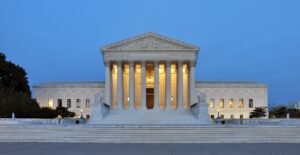
The Supreme Court (Image: Joe Ravi via Creative Commons)
The second of three posts on professions the Trump administration is trying to compromise focuses on the judiciary.
Most of the expert commentary I’ve read is that judges at levels below the Supreme Court have acted in good faith, including those appointed by Republican presidents and even by Trump himself.
The jury seems to be out, so to speak, regarding the Supreme Court. But the trendlines aren’t great. The majority of experts feel that the ruling protecting the president against prosecution for potentially criminal acts conducted within the bounds of “official” duties was a deep betrayal. The consensus also seems to be that the court has kicked the can down the road in important cases by ruling on procedural grounds, not the merits of the case at hand.
The bottom line (to this non lawyer) seems to be that the Supremes only will rule on the key questions themselves when they have no choice. Which way they will go is of course unknowable at this point, but what the conservative block has done so far is cause for worry.
The administration has taken on the judiciary on another front: The attorneys.
This spring, the president issued executive orders (EOs) starkly limiting law firms’ ability to defend clients in actions against the government. It also began coercing firms into providing free services in exchange for relief from the EOs.
Continue reading after the music break…
Without doubt, The Clash’s “London Calling” is one of the greatest videos ever. Even the hazy, poor quality of the video itself contributes to the mood. Shooting it in a light rain on the banks of The Thames brilliantly set the mood of desperation and depression. As I understand it, at the dawn of the radio age channels signing on would begin with by identifying their city or town followed by the word “calling.” If I have that straight, it gives a romantic feel to “London calling.”
Back to the administration and the lawyers…
In April, Bloomberg Law posted a story describing the arrangement with five law firms that netted Trump almost $1 billion free legal services, at least on paper.
It’s a protection racket, no more and no less:
The actions revoked lawyers’ security clearances, restricted their access to federal buildings, targeted diversity programs and canceled clients’ government contracts.
It was reminiscent of the Hobson’s choice faced by a bar being asked to pay protection or be vandalized.
It is worse: A bar choosing to pay up presumably goes on with business as usual. Indeed, the bar likely will benefit because other criminals would know it is paying protection and take their gasoline and matches to bars that hadn’t.
The firms no doubt felt they had no choice but to comply because they would be unable to serve their clients if they had no security clearances or couldn’t physically enter federal buildings.
The strategy seems to be failing. Politico summed up the situation in mid-July:
Trump’s executive orders and the deals struck by the settling firms have not aged well. The firms that threw in the towel appear to have misjudged the fallout — financial, reputational, political and legal. Meanwhile, the Trump administration has gotten hammered by the judges presiding over the cases challenging the White House, and it’s far from clear the government’s appeal will get a better reception in the higher courts, including the Supreme Court, if it gets there. Furthermore, the deals with the settling firms have so far produced scant results for the Trump administration in concrete terms.
Even if the legality of the EOs are confirmed, the administration seems to have poked bears with a high IQs. For instance, in early June Damian Williams, the former U.S. attorney for the Southern District of New York, left Paul Weiss Rifkind Wharton & Garrison. The firm was the first to reach an agreement with the administration. Williams is only one of several attorneys who left the firm.
Another example is tech lawyer Neel Chatterjee. Reuters reported in July that Chatterjee left Goodwin Procter to join King & Spalding, Chatterjee is deeply involved in the legal fight against the EO.
And, as Electoral-Vote.com reports, small firms increasingly are stepping into the breach when their bigger brethren chicken out.
The legal back and forth will be far over my head. But three things are clear: One: It is unacceptable for a presidential administration to try to intimidate and extort firms who otherwise would represent people in actions against the administration. Two: People willing to do that shouldn’t be running the government. Three: The best way to kick those people out of the government is to vote.

