
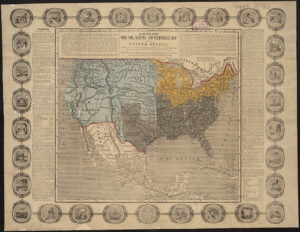
Three surprises: There is an elegant solution to our problem of governance, it already is being implemented and the Supreme Court decision making it feasible was written by conservative icon Antonin Scalia.
The idea is simple. “Soft secession” is the shift of the emphasis of laws and policies from the federal level, where the most power rests today, to the states. Applying the idea to our current struggles would mean that the blue states would simply take care of their own business alone, in partnership with other blue/purple states or with red states if common ground exists. The states don’t enforce federal laws that they consider flawed.
We become the United States of America and the United States of New America.
It’s not exactly what Abraham Lincoln had in mind, but Thomas Jefferson would have been fine with it.
There is nothing revolutionary in the core idea. Jefferson wanted strong states and a weak central government. We have a mix of state and federal rules and laws today. The only thing that would really change is that the states would assert themselves more strongly and become the senior partner in their interactions with Washington.
A Substack by Christopher Armitage entitled It’s Time for Americans to Start Talking About “Soft Secession” explains the concept far better than I can do so. He offers examples of where it already is being implemented and lays out some of the early strategic moves by proponents. What’s very clear is that a lot of very smart people have been working on this for months.
More after the music break…
Since this post is about a form of Civil War, I was going to use the beautiful “Ashokan Farewell” as the music break. After all, the song–which was written by Jay Ungar about an area of SUNY New Paltz, my wife’s alma mater– was a sublime choice by Ken Burn for use in the landmark documentary The Civil War. Soft secession, after all, is a subtle form of civil war.
As I was writing, however, it became apparent that Fleetwood Mac’s “Go Your Own Way” was the better choice simply for the title. The song is from the band’s classic Rumors album. I’ve always been intrigued by the almost complete transformation Fleetwood Mac. It was founded as British blues band in 1967 by Peter Green, who brought in Mick Fleetwood and John McVie. Green was a pure blues player. He played with John Mayall’s legendary Bluebreakers, whose alumni also included Eric Clapton and Mick Taylor. Green, who had mental health issues, left the ban. McVie brought in his wife, Christine. The band became far more pop oriented and the rest, as they say, is history.
Back to soft secession…
The only thing that I would add to Armitage’s terrific explainer is that skillful and ambitious politicians – starting with California and Illinois governors Gavin Newsom and J.B. Pritzker – want to be the Democratic nominee for president. Soft secession is a great way to do this. It is easy to understand, dramatic and has the potential to offer a path forward to people in the center and on the left who are aghast at both where this country is headed and at the apparent lack of resistance by the Democrats.
A bit of broader context is that the red and blue states are not on equal footing now. The system under which we live is inherently tilted toward the red states. Indeed, it’s quite possible that these states have pushed things too far and have messed up what seems to be a pretty good deal.
The states send taxes they collect to Washington. They are divided up and used to support Federal programs. In general, red states generate less tax revenue than blue states. However, the funding they receive is not limited by the amount they contribute. In essence the blue states subsidize the red. A post earlier this year at Time.com looked at the math. Jeffrey Sonnenfeld and Stephen Henriques found that the discrepancy is not small:
We have compiled a first-of-its-kind comprehensive five-year assessment of state-by-state inflows and outflows of federal funds and found the balance of contributions and receipts is not even close, red states are still propped up by blue states. After our researchers analyzed federal expenditures, including the Biden era infrastructure initiatives, Medicare/Medicaid, military spending, government contracts, standard grants, etc., against federal revenues across all 50 states, it is clear that blue states are funding red states.
The blue states have another axe to grind. Red states are overrepresented in the legislative process. All states get two senators. Illinois (population 12.8 million) and Idaho (2 million) each get two. Michigan (10.2 million) and North Dakota (784,000) as well. The list goes on.
This is no accident. The Founding Fathers set it up this way due to the fear that states with urban centers would have dominated barely settled rural states. But, over time, the exact opposite occurred. Rural states turned red. They now rely on this built-in advantage to push through legislation that favors their economies and cultural agendas. The center/left’s long-term frustration at playing second fiddle to a weaker collection of states is likely to make soft session very popular.
Soft Secession is OK, according to Scalia
The commonsense case for disentanglement is strong from both the current and historical perspectives. The kicker is that this modern iteration of the states’ rights versus federalism kicked off by the Supreme Court decision in a 1997 case (Printz v. The United States).
The case dealt with enforcement of the Brady Handgun Violence Prevention Act (which commonly is called the Brady Bill). The question the court considered was whether local chief law enforcement officers could be forced to temporarily perform background checks that are part of the law, which is a federal statute.
The five conservative justices at that time–Antonin Scalia (who wrote the majority opinion), William Rehnquist, Sandra Day O’Connor (concurrence), Anthony Kennedy and Clarence Thomas–decided that the state officials could not be forced to participate. This is called the anti-commandeering doctrine. according to a Medium posting by Vickie Helm. I am not a lawyer, but feel that there is some contradiction between that and the Supremacy Clause of the Constitution which that says that federal law prevails when it contradicts state or local law.
Still another factor driving soft secession is that many blue state residents clearly feel the Supreme Court is corrupt. One seat (held by Neil Gorsuch) was thought to be stolen. There are numerous legal and ethical questions surrounding Clarence Thomas. Elected officials from red states are not willing to explore either situation. Legal experts say some decisions favoring Trump rely upon bizarre interpretations – and some (from the “shadow docket”) offer no reasoning at all.
Whether under such conditions the blue states would abide by a decision demanding that they comply with a decision they feel is deeply wrong is questionable and the product of a jaded court. What also is unclear is what options the administration would have if they did ignore it.
Two philosophies of democratic governance–the anti-commandeering and the unitary executive doctrines–may end up in a winner-take-all battle. The two are diametrically opposite: More power reverts to the states in one and the single chief executive is more or less a king in the other. The lesson may simply be that today hazy mix of three roughly equal branches has grown antiquated.

